
Alaska Inmate Population Records
Alaska inmate population records are available through the state's free VINE search system and the Alaska Department of Corrections, which runs a unified jail and prison system unlike most other states.
Alaska Inmate Population Overview
How to Find Alaska Inmates
The main tool for searching Alaska's inmate population is VINELink, the state's official offender search and victim notification service. VINE stands for Victim Information and Notification Everyday. It's free, available 24 hours a day, seven days a week, and you don't need to create an account just to do a basic search. Anyone can use it to check whether a person is currently in custody and which facility they are at.
To search by name, enter the first and last name on the VINE site. If you're not sure of the full spelling, check the "partial name" box and use at least the first two characters of the last name. Results show the person's name, gender, race, ID number, facility location, and current custody status. You don't need to know which facility to start your search. The system is straightforward. It tells you what you need to know fast.
You can also search by ID number. If you have the inmate's DOC ID but aren't certain of the full number, check the "Partial ID Number" box and enter at least the first four characters, leaving off the leading zero. The VINE toll-free number is 1-800-247-9763 for phone searches. TTY users can call 1-866-847-1298.
The Alaska CourtView system is a separate tool for looking up court case records tied to the state's criminal population. CourtView covers felony and misdemeanor cases. You can search by name, case number, or citation number. Case numbers follow a specific format with leading zeroes and dashes (for example, 3AN-12-00001CR). Each search can return up to 500 records. The docket shows motions filed, bail and fine payments, judicial assignments, and documents on file. Sentencing details and probation conditions aren't shown online, but you can review the full case file at the courthouse.
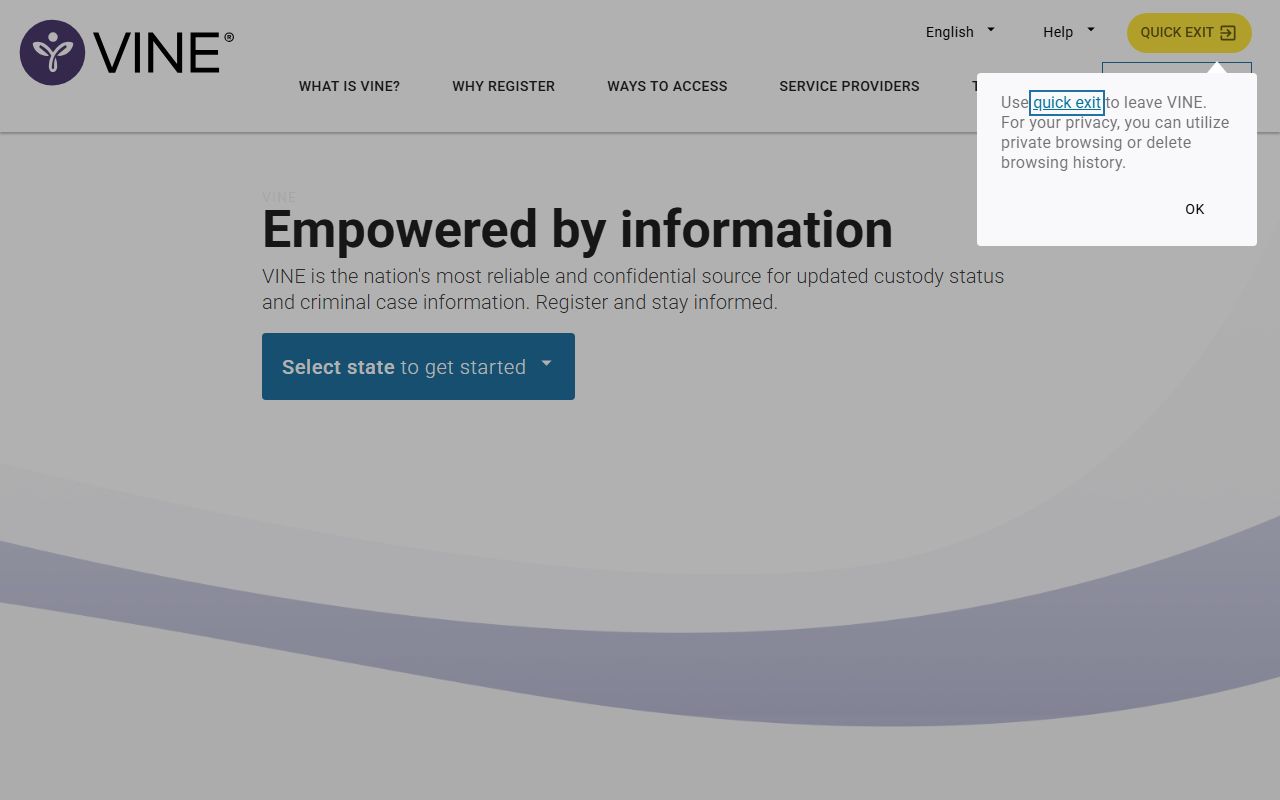
VINE lets users register for notifications when an inmate's custody status changes.
Alaska's Unified Correctional System
Alaska is different from most states in how it manages its incarcerated population. In the lower 48, cities and counties typically run their own jails for short-term pretrial detention, while the state handles prisons for those who've been sentenced. Alaska doesn't work that way. The Alaska Department of Corrections runs both jails and prisons under one unified system. That matters when you're searching for someone: you don't need to know whether the person was sentenced or is still awaiting trial to find the right agency. DOC handles both.
About 4,778 people are currently in Alaska's state system. The incarceration rate is around 205 per 100,000 residents, which is roughly 42.3% lower than the U.S. average. About 9.5% of the state's inmate population is female. The male rate is 370 per 100,000 males; the female rate is 22 per 100,000. In addition to its 13 state-run facilities, DOC contracts with 15 community jails run by local police departments. Alaska also has one private correctional facility operated by Ahtna, Incorporated.
DOC provides educational services, vocational training, health services, and rehabilitation programs across its facilities. If you're trying to understand what programs are available to someone currently confined in the system, the DOC site is the right place to look. Program offerings vary by facility and security level.
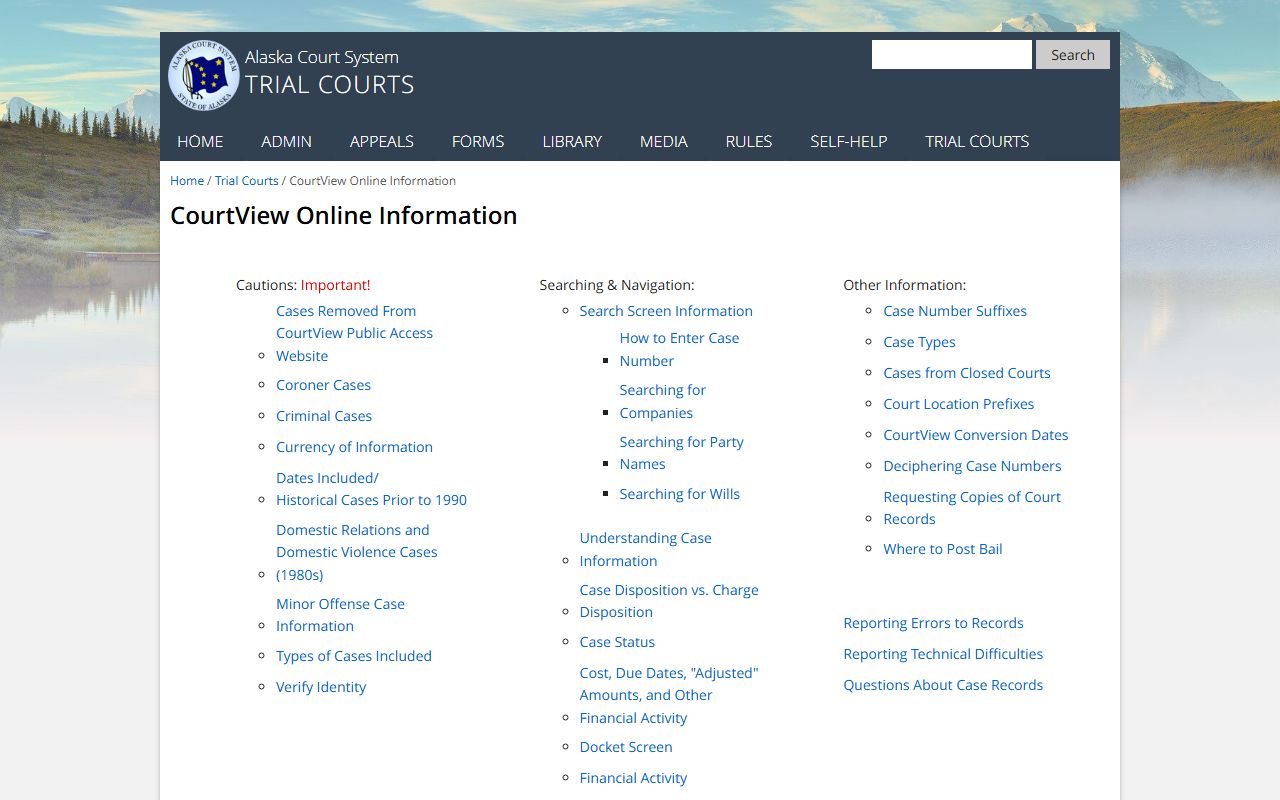
CourtView lets you look up felony and misdemeanor case records by name, case number, or citation number.
Alaska Correctional Facilities
The state's 13 DOC-operated facilities are spread across Alaska, from Ketchikan in the southeast to Anvil Mountain Correctional Center in Nome. Knowing which facility holds a particular inmate matters for in-person visits, mail delivery, and phone calls. VINE will tell you the current location if you don't already know it.
In the Southcentral region, facilities include Anchorage Correctional Complex, Goose Creek Correctional Center, Hiland Mountain Correctional Center (which houses female inmates), Mat-Su Pretrial, and Palmer Correctional Center. Fairbanks Correctional Center serves Interior Alaska. Lemon Creek Correctional Center and Ketchikan Correctional Center are in Southeast Alaska. On the Kenai Peninsula, you'll find Wildwood Correctional Center and Spring Creek Correctional Center. Anvil Mountain Correctional Center is in Nome. Yukon Kuskokwim Correctional Center serves the western region of the state. Point Mackenzie Correctional Farm is also part of the DOC network.
Each facility has its own mailing address, phone number, and visitation schedule. Visitation rules vary by facility and custody level. Check the DOC website for current addresses and contact details before planning a trip or sending mail.
Alaska Public Records Act
The Alaska Public Records Act (APRA) is at AS 40.25.100 through AS 40.25.295. It gives the public the right to inspect government records, including those held by the Department of Corrections and other state agencies. The Alaska Supreme Court has consistently interpreted public records laws in favor of disclosure. Exceptions must be narrowly read.
Under AS 40.25.110, an agency must give you an initial response within 10 working days of receiving your request. If a search or copying task takes more than five person-hours per month, the agency can charge an hourly rate for that extra time. The act defines "records" broadly to include anything "regardless of format or physical characteristics" that a public agency developed or received in the course of its work.
Not every record is open. AS 40.25.120 lists specific exemptions: vital statistics, juvenile records, medical records, law enforcement records that could interfere with a pending investigation or proceeding, and records that identify victims and witnesses. Under AS 12.61.140, names of victims of certain offenses are withheld from public records and replaced with initials. The Victims Rights Act of 1991 also restricts access to addresses and identifying information for victims of sexual assault, sexual abuse of a minor, and kidnapping.
To make a public records request to the Alaska Department of Law, email law.recordsrequest@alaska.gov or write to 1031 West 4th Avenue, Suite 200, Anchorage, AK 99501. For DOC-specific records, contact that agency directly through the DOC website.
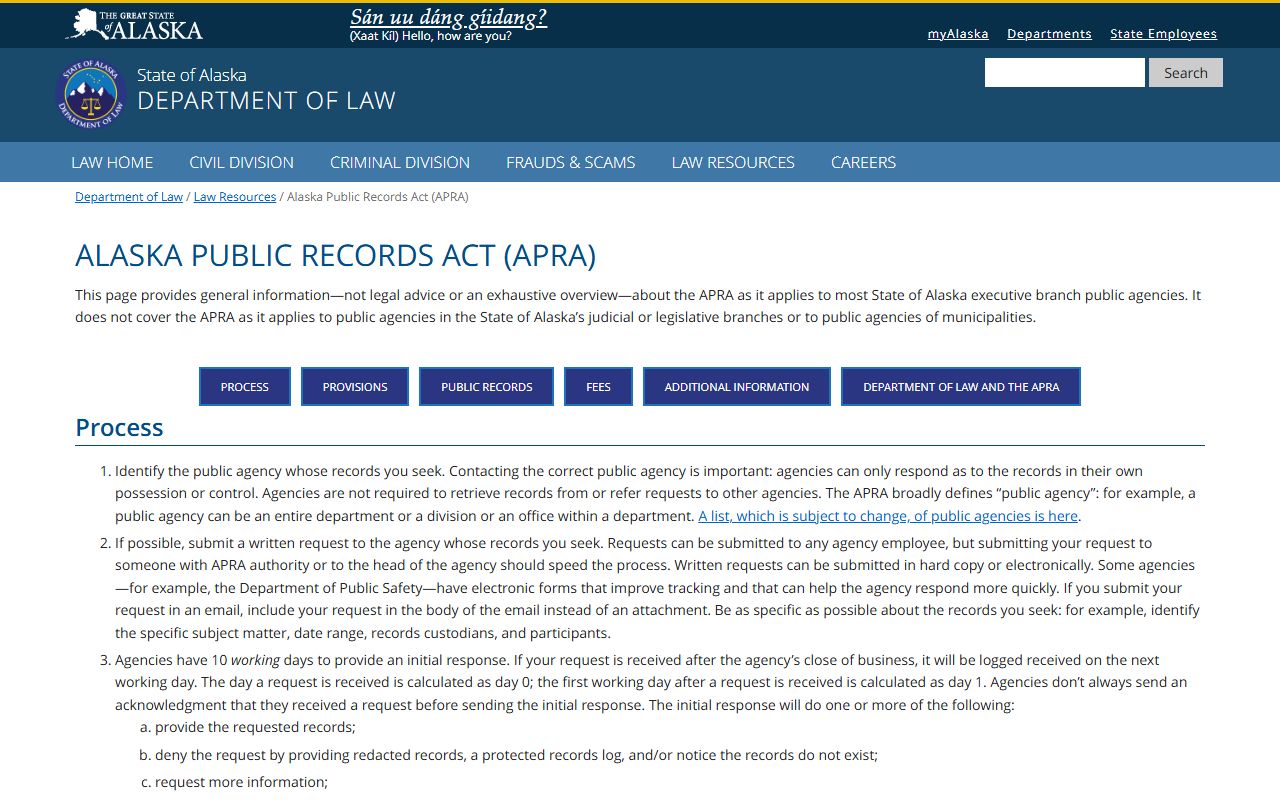
The Department of Law publishes APRA guidance to help people understand their right to access government records in Alaska.
Note: Juvenile records and medical records are exempt from public disclosure under AS 40.25.120, even when they relate to an incarcerated individual.
Criminal Records and Background Checks
The Alaska Department of Public Safety Records and Identification Bureau maintains the state's criminal justice information under AS 12.62.160. That statute allows "any person" to request Alaska criminal justice information. This is broader than many states allow. You don't need a specific legal reason or a relationship to the subject of the record.
Two types of checks are available. A name-based check costs $20. A fingerprint-based check costs $35. The fingerprint check is more reliable since it confirms identity and catches records filed under aliases. Fingerprints must be on a standard FD-258 FBI fingerprint card. Results from fingerprint-based checks are mailed within two to three weeks.
The bureau is located at 5700 East Tudor Road, Anchorage, Alaska 99507. Phone: (907) 269-5767. Email: dps.criminal.records@alaska.gov. Forms and instructions are available on the DPS website.
Victim Notification in Alaska
Alaska law gives crime victims the right to be notified throughout the criminal justice process. That includes notice about the crime, the court case, the sentence imposed, and the release date. Two systems handle this in practice: VINE for custody and release notifications, and the DOC Victim Service Unit for ongoing case-related updates tied to a specific inmate in the correctional system.
VINE registration is free and fully confidential. Inmates will not know you've registered. To sign up, go to VINELink and create a four-digit PIN. You can add multiple phone numbers and email addresses to your account. No PIN is needed for email notifications. If VINE calls and you miss it, the system calls back until you enter your PIN or 24 hours pass. VINE covers transfers between facilities, releases from custody, and escapes. It's the fastest way to know when an inmate's status changes.
For updates on a specific open case or upcoming court hearing, contact the local office handling the case. You can also reach out to the court directly. The Alaska Violent Crimes Compensation Board has information about victim rights and the full notification process, including how to get help if you're not sure where to start.
The DOC Victim Service Unit handles notification requests that go beyond what VINE covers. Call 877-741-0741 to reach the unit. They can help with specific case updates and long-term monitoring of an inmate's status in the system.
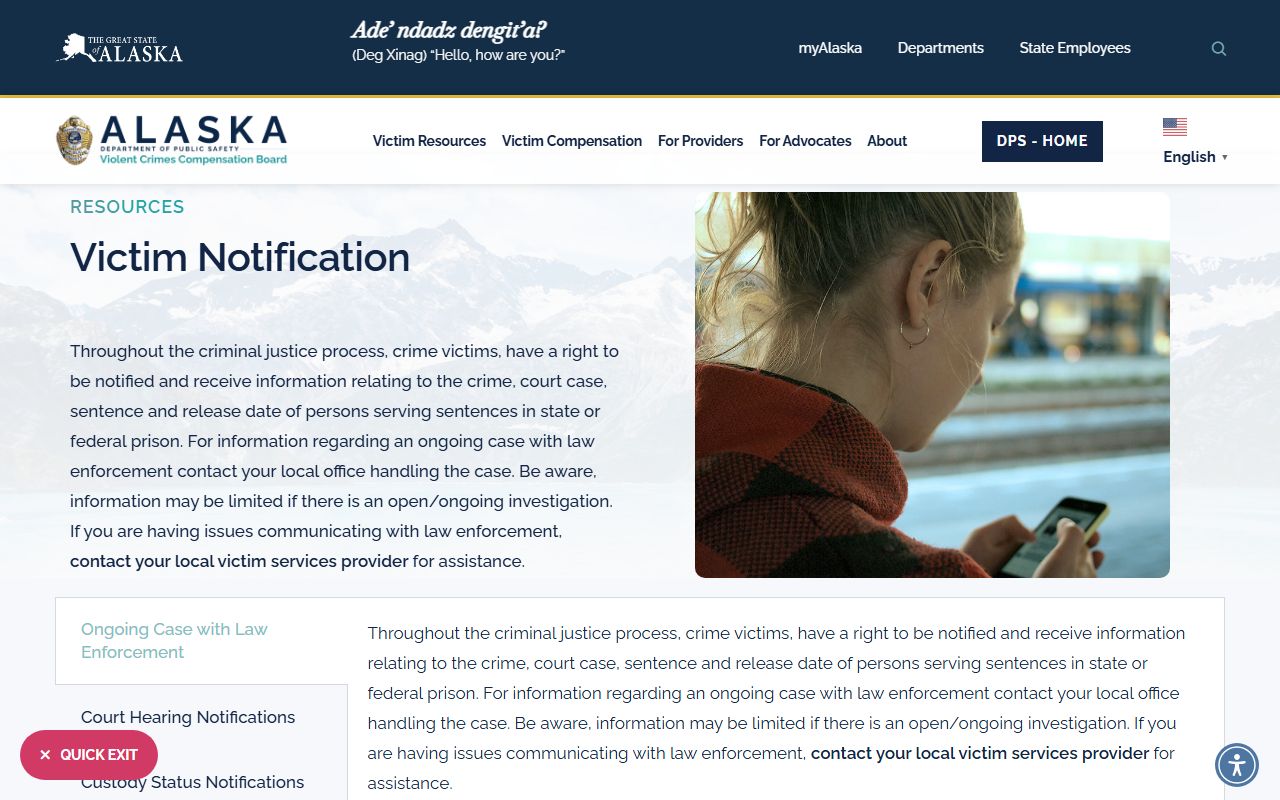
The VCCB page explains what information victims can receive and how to register for ongoing custody updates.
Note: If there is an open investigation, some case details may be withheld even from registered victims under Alaska state law.
Alaska Statutes on Inmate Records Access
Several Alaska statutes govern how inmate population records are created, kept, and accessed. Title 33 of the Alaska Statutes covers the corrections system, including DOC authority over prisons, prisoners, probation, and parole. Title 40, Chapter 25 is the Alaska Public Records Act. Title 12, Chapter 62 covers criminal justice information and who can get criminal history records.
The Alaska statutes database is the official source maintained by the Alaska Legislature. It's searchable by title, chapter, and section number. If you need to know your rights around accessing records or understand the rules that govern DOC operations, it's the place to start.
The Reporters Committee open government guide for Alaska gives a plain-language breakdown of how the state's public records laws work in real situations, including how courts have interpreted the act over time.
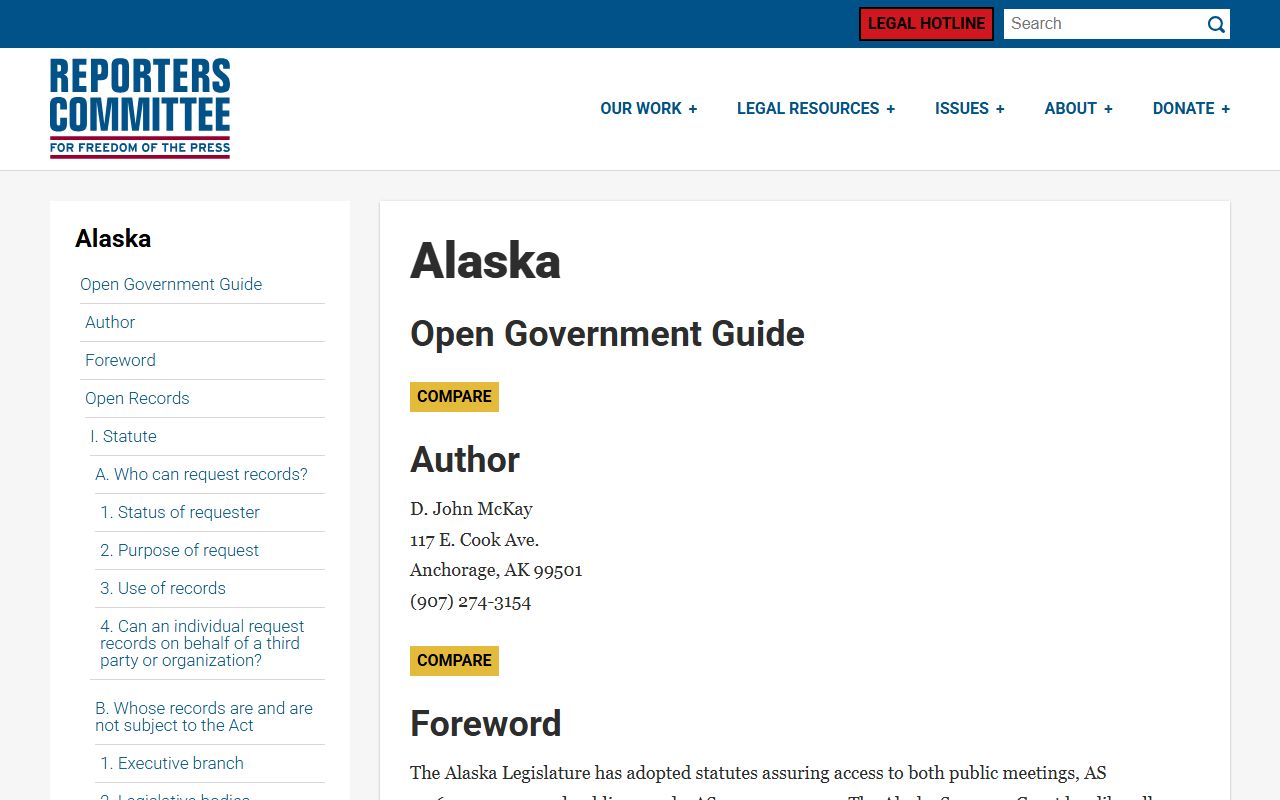
The guide covers key Alaska court decisions on public records access and how disclosure exemptions are applied.
The ALA State Agency Databases Project compiles links to official prisoner databases across all 50 states, including Alaska's VINE system.
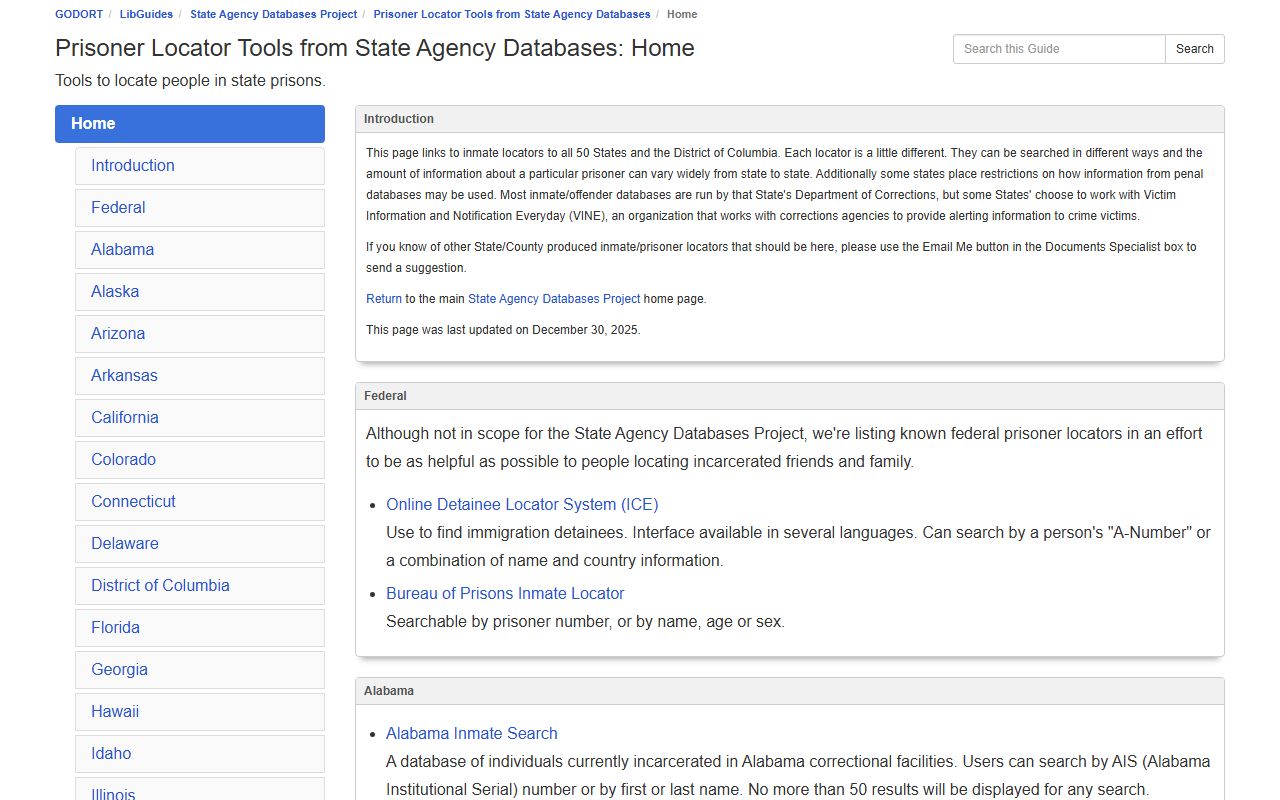
This library resource helps users find official inmate search tools for each state, including Alaska.
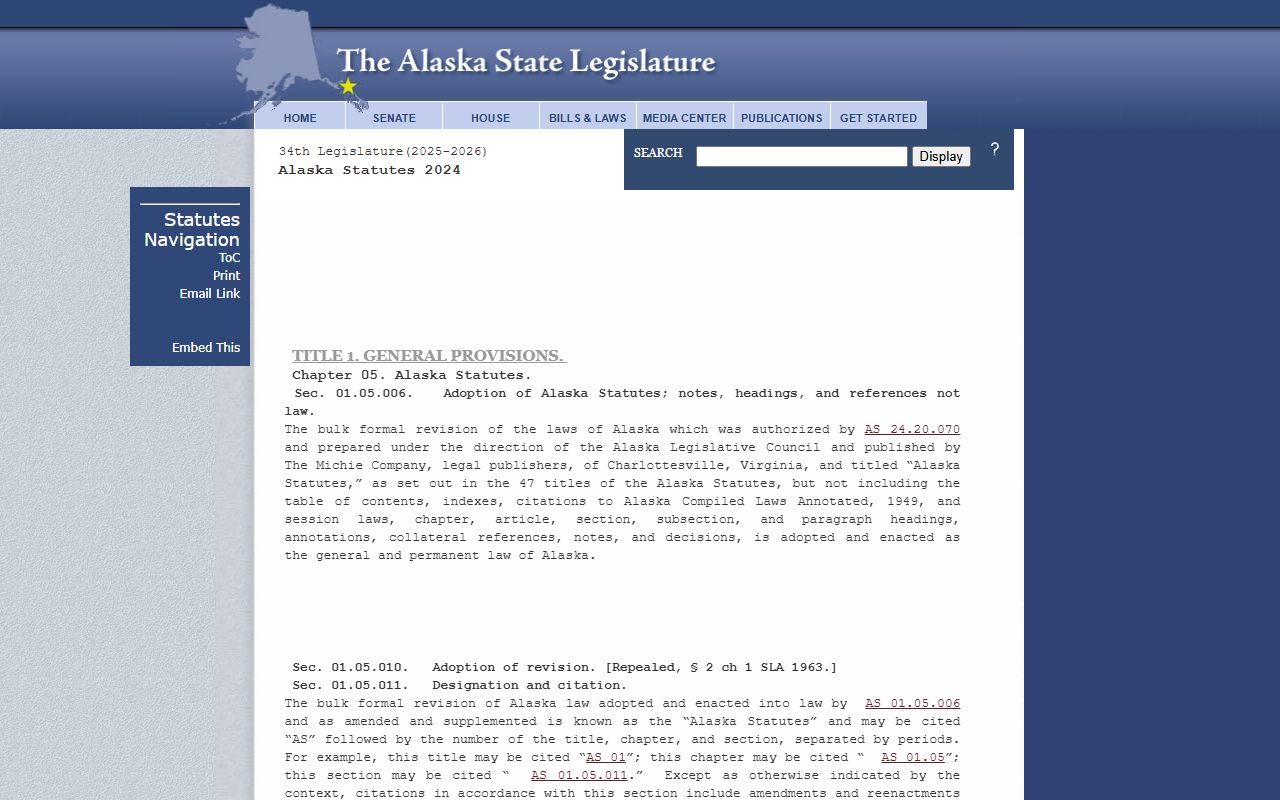
The statutes database lets you search Title 33 for corrections law and Title 40 for public records access rules.
Browse Alaska Inmate Population Records
Alaska's inmate population is managed at the state level through DOC, but court records and local case filings are organized by borough and census area. Use the links below to find records and resources by location.
Alaska Boroughs and Census Areas
Alaska has 30 boroughs and census areas. Each is served by Alaska Court System district and superior courts that handle criminal case filings. Browse by borough to find local court details, nearby DOC facilities, and how to access case records in that area.
Major Alaska Cities
Alaska's largest cities are served by state DOC facilities and Alaska Court System courts. Select a city to find inmate population records, court access information, and local resources.
View All Alaska Cities →